
If there is one thing we can say for sure, it’s that humans are terrible at analyzing trade-offs. We are terrible at envisioning them before they occur, and we often fail to recognize them after they arrive. This is what Marshall McLuhan meant when he said that self-amputation forbids self-recognition. Yet every time we apply technology to a task or problem, trade-offs occur and unexpected consequences follow.
I remember when people thought social media was just a silly platform for sharing pictures of their dinner. This perspective seems downright naive in hindsight. Yet this pattern repeats itself again and again.
In my previous article on why augmentation is amputation, I introduced a process called ARM (Awareness, Recognition, and Mitigation). This process helps identify and defend the skills you care about. In this article, I’m releasing something to help you understand the trade-offs involved in applying technology to tasks so you can identify negative impacts and account for them.
Even though we know trade-offs happen, we still do nothing about them. There is no attempt at analysis, only adoption. This is why I created The Technology Impact Bowtie.
The Technology Impact Bowtie
Whenever you ask people what skills they need for the future, analyzing trade-offs is noticeably absent. However, I believe analyzing trade-offs is one of the most important skills people can develop in our chaotic, uncertain times. We often rush to push technology as fast as we can, everywhere we can, without ever considering the negative impacts.
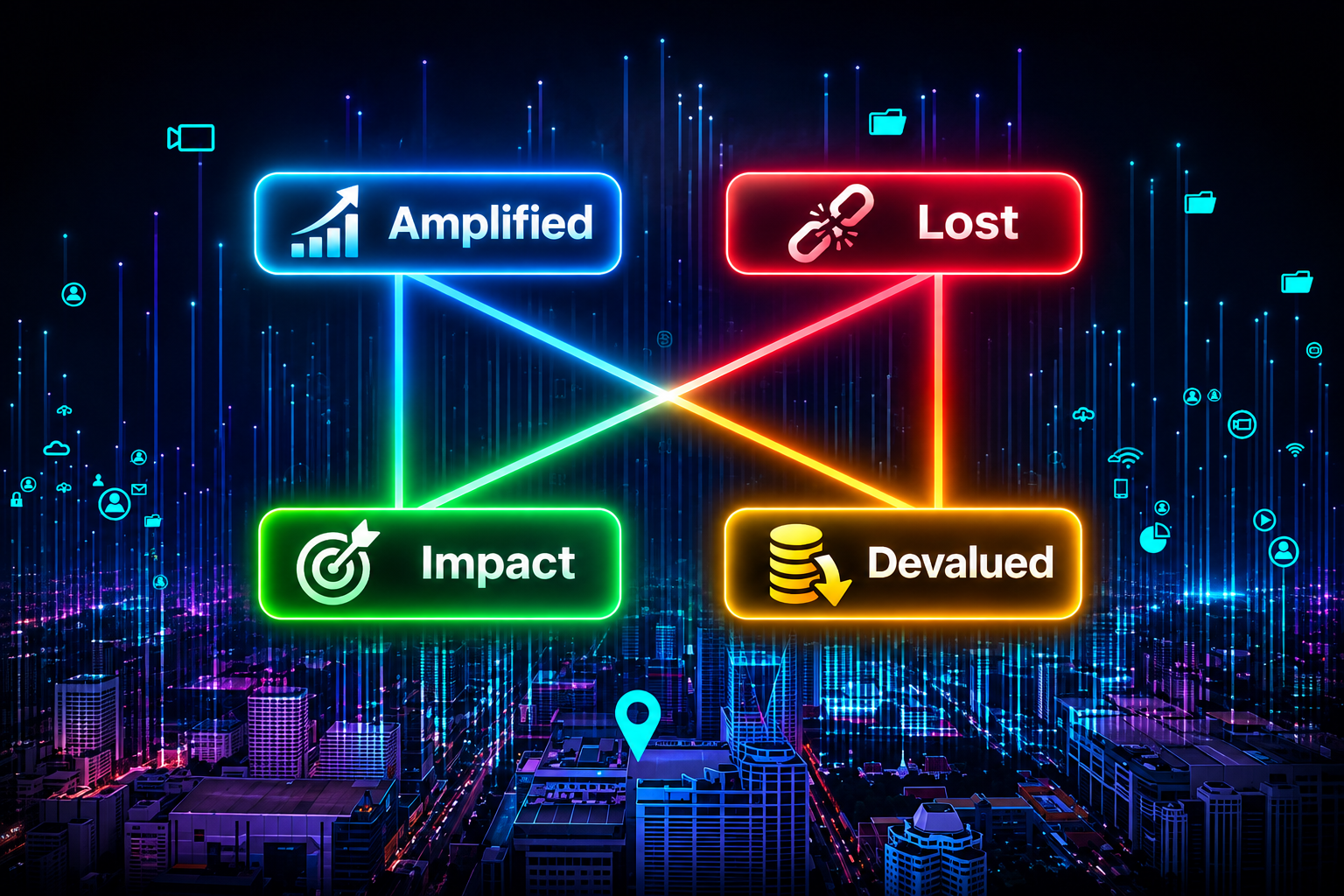
During my keynote at Black Hat India, I introduced what I call The Technology Impact Bowtie (TIB) as a way to surface impacts when applying technology to tasks or problems. It makes potential negative impacts visible when other factors often obscure them.

Every time we apply technology to a task or skill area, something is amplified, devalued, and lost, creating impacts. It’s key to surface these impacts so we can account for them.
Often, when applying technology, most of the focus is on what it amplifies and any positive impacts this creates. This amplification obscures other factors, since the amplification is visual and often the reason technology is applied in the first place.
The Technology Impact Bowtie is inspired by the McLuhan Tetrad of Media Effects. However, the McLuhan Tetrad focuses on a specific medium and its overall effects on society, whereas the TIB is a practical approach used when applying technology to a given task or skill. This practicality makes the TIB much more actionable for people and organizations.
Applying the TIB doesn’t have to be some large formal exercise. The TIB is a model, and you can potentially do it entirely in your head, depending on the situation. It can be as simple or as complex as you like.
AI Coding Example
Let’s look at an AI coding example. What follows are just a few simple values for demonstration. For each category, you’d want something a bit more comprehensive to ensure you are capturing the scope of negative effects.
- What’s Amplified
The ability to automatically generate code and entire programs, including program testing.
- What’s Devalued
Human coding abilities.
- What’s Lost
Code comprehension and understanding. Foundational technology skills.
- What’s the Impact
Bugs and security issues make it into applications. Failures more difficult to troubleshoot. Technical debt continues to add up.
You can expand on each category of the bowtie by adding more data. This is especially true in the impacts section. For example, losing a skill can create many different impacts that you’d want to account for, which is the whole goal of the process.
Conclusion
As humans are increasingly devalued in technological processes, it’s important that we keep the skills that matter to us. We can’t keep our systems in check if we lose the ability to do so. A big part of retaining these skills is the ability to identify trade-offs. Using the Technology Impact Bowtie and ARM together can be a powerful way to curb the negative impacts of technology adoption, stave off negative consequences, and protect what we care about.