
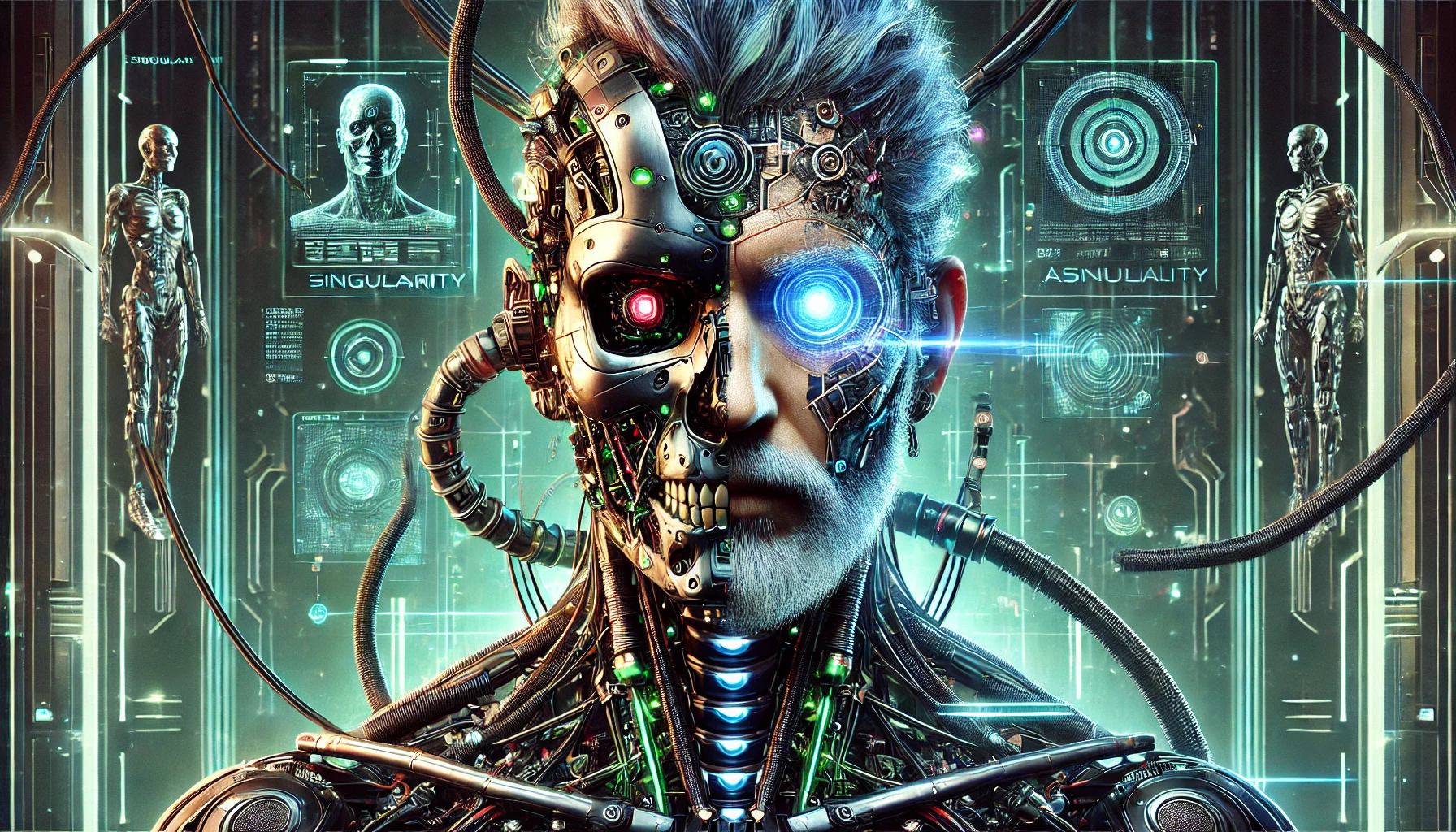
In just a few short years, we’ll not only have achieved AGI but live in a world of abundance. Physical goods will be so cheap that they’ll basically be free, and we’ll be able to 3D print anything we’d like. One can only assume with their free 3D printer. We’ll connect our brains to the cloud and have seemingly endless compute, which will also essentially be free. We’ll have cured our illnesses, created replicants, and become immortal. This is but a taste of the nonsense peddled by Ray Kurzweil.
In his new book, The Singularity is Nearer: When We Merge with AI, he pushes a couple of themes. One is that all technological advancements will be universally positive. Second, the only way humans can ever hope to compete is by fully merging with technology. I have issues with both of these themes. This post attempts to address only a tiny amount of the BS in the book.
Ray Kurzweil
If you are unfamiliar with Ray Kurzweil, he’s someone propped up by many as the preeminent futurist. I recently caught one of his appearances, and his ramblings elicited a noticeable grimace from me. I must admit, I wasn’t familiar with his unique brand of absurdity. I knew he’d said some wacky stuff in the past and had a book about the singularity, but I didn’t pay him much attention. After this interview, I purchased his new book, The Singularity Is Nearer: When We Merge with AI.
The strange thing about Kurzweil is the way people treat him during interviews. I haven’t really seen anyone push him on his asininity. When interviewers attempt to question him, he makes up more nonsense and says things like if people can live 20 more years, they’ll be able to live indefinitely or that things will be free in the future, avoiding the question altogether.
The book demonstrates how disconnected and out of touch Kurzweil is from reality. But it also highlights a bigger problem. As long as tech is allowed to be presented as magic, charlatans and hucksters will run rampant. This is the playbook that Kurzweil exploits. Unfortunately, I don’t have the time to address all of the issues with the book, but I will point out a few things that stood out to me.
As long as tech is allowed to be presented as magic, charlatans and hucksters will run rampant.
Before We Start
A few thoughts before we begin. If you read the reviews of this book, they are overwhelmingly positive. I’m sure many people won’t care for this post. Kurzweil is a famous tech personality with multiple books, TV appearances, and impressive credentials. I’m a nobody security researcher. I’ll never be in demand like Kurzweil or sell as many books as him, so I’ll have to cry myself to sleep at night with my integrity intact.

After all, he was just listed on the Time100/AI list, which caused me to laugh out loud. Then again, we live in a performative age, and Kurzweil is a performer.
However, I’ve spent my entire career analyzing risks and envisioning future threats to technology, something Kurzweil is oblivious to or completely ignores. Neither is a good scenario.
It’s also important to know that Kurzweil has been wrong many, many times before. I stumbled upon this old Newsweek article from 2009, which had an amazing quote.
P. Z. Myers, a biologist at the University of Minnesota, Morris, who has used his blog to poke fun at Kurzweil and other armchair futurists who, according to Myers, rely on junk science and don't understand basic biology. "I am completely baffled by Kurzweil's popularity, and in particular the respect he gets in some circles, since his claims simply do not hold up to even casually critical examination," writes Myers. He says Kurzweil's Singularity theories are closer to a deluded religious movement than they are to science. "It's a New Age spiritualism—that's all it is," Myers says. "Even geeks want to find God somewhere, and Kurzweil provides it for them."The author even made a midlife crisis joke and another person accused him of trying to start a religion. Fifteen years, and not much has changed.
Let me also say that given enough time and technological progress, just about anything is possible. I think this is something that everyone innately knows. However, people like Kurzweil exploit this instinct for their benefit, running up the clock and leveraging the hype. We should be aware of this trick when evaluating claims.
Why Write This?
You might ask, why would I dedicate time to writing this article out of all the other things I could be writing? Indeed, I’d rather be writing something else, but as I was sketching my thoughts for this post, I read an article with the following quote.
“A colleague of mine, without a hint of irony, claimed that because of AI, high school education would be obsolete within five years, and that by 2029 we would live in an egalitarian paradise, free from menial labor. This prediction, inspired by Ray Kurzweil’s forecast of the “AI Singularity,” suggests a future brimming with utopian promises.”THIS is why I’m writing it. These predictions powered by Kurzweil are fabricated bullshit. Let me go on record and say we won’t have AGI by 2029 or a utopia. Now, I’m not delusional in thinking that I would have nearly the reach needed to make a dent in Kurzweil’s impact, but I’ll reach a few people and get this off my chest. So, let’s dive in and call it like it is.
Kurzweil is a BS Artist
If I had to summarize The Singularity Is Nearer, I’d say it’s the ramblings of an aging gentleman confronted with his mortality, hoping that wishful thinking and vibes are enough to speed the tech he imagines into existence. It’s a book of absurdity wrapped in historical and disconnected examples attempting to give Kurzweil’s bullshit credibility. Even the title of the book is a sleight of hand. Sure, everything is nearer than when his previous book was written, but that doesn’t mean it’s close.
Another obvious fact on display is that if Kurzweil found himself down at the crossroads, we know exactly what he’d sell his soul for. He wants to become a robot so badly that he’s willing to shed every bit of his humanity to get it. Oddly enough, this doesn’t seem to be the bright, wavy red flag it should be. He’s so scared of death that he’s willing to discontinue being human for a small taste of an extended life.
Why Are People Convinced?
So, if my statements are true, then why is the book so convincing and the reviews universally positive? It’s not because people are stupid, but something far more simple. The book doesn’t continually and all at once slap you in the face with his flatulence. The pungent aroma is layered between positive messages (a utopia, immortality, etc.), topics that have nothing to do with this title, and historical examples of technological progress. This layering is a mental sleight of hand that has a reinforcing effect. Let me give you an example.
Imagine I wrote a book claiming that within ten years, humans would be exploring and populating the cosmos outside of our solar system. Rather than go into the specifics of my claim and address the real risks and challenges, I spend most of the pages talking about other things. I discuss at length the history of NASA and the challenges conquered to put humans on the moon, all in the span of a decade. I talk about the potential of solar sails and other propulsion technologies. I even go off on a tangent imagining the impact on humanity of having a working Dyson sphere. Kurzweil employed the same distraction techniques instead of making points or providing supporting evidence in his book.
The book itself has little to do with its title. He dedicates only a small portion of the text to this topic. He really wants you to know that, based on his vibes, utopia, and immortality are just a few years away. Kurzweil claims we’ll have a utopia in the next 20 years. It’s an easy sell since many people reading his book will still be alive. The entire book consists of telling people what they want to hear. He spends no time talking about challenges or issues. He knows that you sell a lot more books telling people what they want to hear rather than confronting hard truths. This sums up so much of our current age.
He knows that you sell a lot more books telling people what they want to hear rather than confronting hard truths.
That said, the book is an informative glimpse into the mindset of a certain type of person. These would be people with the transhumanist, posthumanist, or e/acc mindset. So much of the transhumanist argument is framed around making us better humans, but it’s really about making us into machines. I’m sure Kurzweil believes he describes a utopia. But like so many utopias, it’s just a thin layer of cheap wallpaper over a dystopia.
So much of the transhumanist argument is framed around making us better humans, but it’s really about making us into machines.
Disconnected From Reality
Kurzweil gives some of the most absurd examples in this book, proving that he has no idea how the world works and is disconnected from reality altogether. For example, after connecting our brains to the cloud, he imagines entertainment where we don’t merely watch a movie but feel the actor’s complex and disorganized emotions. Uhm… Can someone please tell him that actors are… well… acting? He doesn’t seem to realize that people acting in movies are expressing emotions, not feeling emotions. When we insist a tortured character in a movie needs to actually be tortured for entertainment, whose utopia are we living in?
Virtual Experiences
The book has an obsession with virtual experiences. He imagines scenarios such as a virtual beach vacation for your family, where you have the sights and smells of an actual beach. Nothing like taking a vacation with your family while, in reality, not taking a vacation. It reminds me of the company Rekal from the Philip K. Dick short story We Can Remember It For You Wholesale, which became the movie Total Recall for those who never read the story. I don’t know what it is with these people who seem to look at a dystopian SciFi and say, “Yes, that’s the technology we need.” These are cheap illusions that don’t have the impact of the real thing, but not to Kurzweil.
He claims simulations will be so good that there will be no point in doing the real thing and uses the example of climbing Mount Everest, which demonstrates he doesn’t understand what stakes are or what the point of doing something challenging is in the first place. In many cases, the point of performing the activity is the friction and difficulty. We just had the Olympics. Imagine telling Simone Biles, “Why put all of that hard work into competition? Soon, you’ll be able to ‘experience’ Olympic competition.” What Kurzweil doesn’t understand is that when experiences become easy, they lose their value.
When experiences become easy, they lose their value.
Confronted With His Aging
In many ways Kurzweil is keenly aware of his aging. This is obvious in his obsession with simple technology like replicants, which are merely trained on your writings. He discusses the replicant he made of his deceased father and rambles on about how fooled he was by his creation. This experiment was supposed to demonstrate the impressive capabilities of today’s technology, but it ended up just being sad.
However, what’s the point of having a chatbot trained on your writings and other material that exists after you pass away? It’s not you. It doesn’t have your identity or your true thoughts, nor does it encapsulate the complexities that make up your true identity. Even if you could create a more exact replicant, what’s the point? It still won’t be you. It could be a perfect copy of you, but it isn’t you. This is the kind of thing a narcissist would want. I don’t want a copy of myself running around, and I’m sure the world thanks me for that.
When you think more deeply about them, replicants have another problem. They are a get-out-of-jail-free card for not doing the right thing. Why spend time with your loved ones when they are alive if you can create a cheap copy to chat with at your convenience after they are gone? More time doing what you want and less time spending with the ones you love.
Things Will Cost Nothing
Not only will things be better in the future, goods will basically cost nothing. Kurzweil says that everything will become information technology, and the cost will go to zero or nearly zero, even basic necessities like food and clothing. He uses this transformation to say people won’t fight over resources anymore and uses a silly example, such as people fighting over a PDF. The whole premise is absurd. Vertical farming won’t drive food costs to zero, and people will fight over information. People get into fights over social media posts all the time.
Speaking of social media, he makes more ridiculous claims about social media and the cost/value tradeoffs. For example, he says it costs companies like Facebook, Google, and TikTok nothing after they’ve built their infrastructure, suspiciously omitting the energy costs and maintenance to run the infrastructure and the veritable army of people these organizations employ. He justifies his claim by stating that there’s no difference in cost between connecting you to a hundred people or a thousand people, as though the connection between people is where the cost is, but that’s not the stupidest part.
He says that if you could make $20 mowing a lawn but choose to spend that time on TikTok instead, then TikTok is worth $20 to you. This is asinine. Not every action you take in life is in service to make money, and not every free moment is a lost opportunity, either. So, in Kurzweil’s logic, if you could make $5 on Fiverr by designing a logo for someone but decide to sleep instead, then sleep is worth $5. You could make that $5 the next morning with no money lost. None of this even considers algorithms, the addictive nature of social media, and humans just wasting time.
Another spit-take moment is his discussion of radical life extension technology, which he states will not be available solely to the wealthy but also to the less fortunate worldwide. To prove this point, he uses the mobile phone as an example. Nope, you read that right.
Kurzweil says that since most people on the planet have a mobile phone, radical life extension technology will be available to them in much the same way due to extremely low cost. However, I think the mobile phone analogy is worth a deeper look. There’s a big difference between the iPhone in my pocket and an adware-riddled cheap cell phone subsidized by some company squeezing every drop of data from a user that it can. Tack onto this subsidized connectivity like Facebook’s Free Basics program meant to provide free internet to users in developing countries, which ultimately traps them in a Facebook hellscape, and you have the blueprint for something fairly dystopian.
Continuing his cost-nothing crusade, Kurzweil states that using robotics, cheap energy, and automation to replace labor outright in the 2030s would make it relatively inexpensive to live at a level considered luxurious. Telling people things will be cheaper, but you won’t be able to afford them because you don’t have a job is a contradiction that apparently didn’t dawn on him when he wrote that passage.
And… I’m not even going to get into his Bitcoin comments.
Jobs and Wages
Kurzweil has odd claims about jobs and wages. For example, he claims that more jobs will be created than lost, but he can’t answer what those jobs will be because they haven’t been invented yet. He uses examples like farming and the textile industry to prove his point. But this doesn’t make sense since AI is a far more generalized technology than a tractor or the power loom and can cross many different industries.
On wage stagnation, he boasts about how stagnated wages can buy more compute. Imagine that conversation with your family when having to skip a meal because you can’t afford food. “I know you are hungry, kids, but just think about how much more compute we have!”
I know you are hungry, kids, but just think about how much more compute we have!
One of Kurzweil’s favorite scare tactics is claiming there won’t be jobs for unenhanced humans and stating that until we fully merge with AI, there will be almost no jobs left. He makes multiple claims throughout the book on this point, saying biological brains cannot keep up with non-biological precision nanoengineering. Whatever the f—k that word salad means. This is another one of Kurzweil’s tactics on display. He knows most people know nothing about nanoengineering, so he bloviates on the topic. For good measure, he also mentions a world where we watch political ads or share personal data to get free nano-manufactured products. Ah, yes. The utopia we were all hoping for.
When it comes to automation replacing and disrupting the job market, he brings up a silver lining. The gig economy. He mentions the gig economy offers people more flexibility, autonomy, and leisure time. Kurzweil is so out of touch he doesn’t realize these aren’t the same thing. Once again, imagine that conversation. Telling someone who delivers for DoorDash, “Sure, you don’t have a regular job that pays well enough or has benefits, but isn’t all that leisure time great?” When you can’t pay your bills, downtime isn’t leisure time.
When you can’t pay your bills, downtime isn’t leisure time.
Being Human

In one part of the book, he questions what being human even means when introducing non-biological components and brain-computer interfaces. This is actually a great question, which, of course, Kurzweil doesn’t answer. Instead of answering, he vomits more of his pontification about inevitability, saying the non-biological component will grow exponentially while our biological intelligence will stay the same, providing a more specific prediction that in the 2030’s our thinking itself will be largely non-biological. Kurzweil has a way of stating questions as though he’ll answer them but never answering them. This is how a con artist operates, appearing to be upfront.
It should be obvious to anyone reading the book that Kurzweil really doesn’t like being human and yearns for the day to transform into something else. It doesn’t even matter to him what he becomes as long as it isn’t human.
For example, it’s uncomfortable (but necessary) to think about how replacing our biological components with synthetic ones may change us, especially when it’s not for the better. Instead of addressing this complicated reality, he makes the point that we remain the same person despite our cells going through a replacement process and our brains being almost completely replaced over the span of a few months. The implication he hopes you draw is that this non-biological replacement shouldn’t bother us. Once again, more absurdity.
Bodily regenerative processes are not the same as a wholesale replacement by synthetic alternatives. This holds true for both physical and cognitive functions. This irritates me to no end, and it’s one of the most obvious flaws in his logic. Kurzweil hopes to smother us with a pillow while he whispers, “Just let the singularity happen.”
No Downsides
One of the most apparent aspects to readers of the book is Kurzweil’s failure to mention nearly any negative aspects or potential adverse outcomes in his book. Either he’s oblivious to them or feels that adverse outcomes don’t align with his message. My guess is it’s a mixture of both.
I’ve discussed many of these downsides already, but one in particular is his presentation of simulation and self-driving cars as though they’re magic. To support this, he mentions the success of companies like Waymo. There is never a mention of Waymo’s issues, such as how these cars have been found driving down the wrong side of the road or mysteriously honking their horns. We don’t have capable Level 5 self-driving cars on the road today, and this problem is not solved. Every company working on self-driving features, from Waymo to Tesla, has issues they cannot solve today.
These are undoubtedly solvable issues, and we will have full driverless technology in the future, possibly even in the near future, but today, these companies can’t solve the problems. It’s undoubtedly disingenuous to talk about driverless cars as though they are a solved problem today.
Okay Not Knowing
Another of Kurzweil’s comfortabilities is agreeableness to not knowing how AI works or comes to its conclusions. He mentions that we may not know or understand even if explanations were provided. It’s odd that he mentions this while talking about the judicial system, an area that’s been plagued with algorithmic issues. Even outside of the judicial system and policing, there have been so many instances where algorithms have unfairly discriminated against people, denying them benefits and even entry into schools. Recently, it was announced that Nevada will use Google’s AI to determine whether people get benefits. People have a right to know why they were denied benefits, and it can’t be, “because the algorithm says so.”
Imagine an air traffic control AI that instructs pilots to fly figure 8’s around the airport before landing. Will we question this or receive it as some sort of hidden knowledge that the AI system has that we can’t fathom? This would be an obvious example that the system has an issue, but countless hidden issues wouldn’t surface in the same way. When we don’t understand how a system came to its conclusions, we set ourselves up for confounders to run rampant.
As I read the section on the judicial system, I wondered how you would ever get a fair trial by jury in the future. When everyone is permanently connected and has access to data that biases them, it may be possible for anyone to get away with a crime purely by spending enough money to taint the data. Or will you be forced to install the JuryBlocker software directly into your cognitive processes? I’m sure Kurzweil would think this thought exercise is silly because the goal is to remove humans from the judicial process altogether, but as we know, we don’t live in a perfect world. Our technology is rarely that good, and humans have a habit of not making the right decisions.
Not The Whole Story
There were so many parts of the book where Kurzweil would bring something up, and I’d be left with the thought, “That’s not the whole story.”
For example, he references things like ChatGPT passing the Bar Exam or AlphaGo beating the best Go player in the world but never tells the whole story. For example, when ChatGPT passed the Bar exam, it also passed other similar standardized tests. Researchers reworded the questions to ask the same question differently, and ChatGPT failed, proving that it had memorized data in its training data. Kurzweil wants you to believe that because of this, a lawyer’s days as a profession are numbered, but his exercise misses the more significant point that lawyers don’t sit around answering Bar exam questions all day.
AlphaGo was a truly amazing accomplishment, but Kurzweil leaves out that even average Go players can beat superhuman Go AIs these days. They can exploit these systems through adversarial policy attacks. These attacks are highly concerning if the technology is deployed in high-risk scenarios outside the game of Go.
In his discussion about disruption from AI, he claims that sometimes there aren’t any losers. For example, a revenue stream from treating a particular illness. He says there are many areas of technological change where losers don’t exist and gives the example of creating a cure for a disease. In this scenario, companies and individuals lose a long-term stream of revenue. This is another one of those sleight-of-hand things Kurzweil does. The cure is indeed more beneficial to society, but that’s certainly not how things play out in practice as large pharmaceutical companies hang on to revenue streams. No matter how cloud-connected your brain is, you won’t be able to compete with large organizations and a mobilized workforce. There may be occasional exceptions, but it’s hardly the rule.
Conclusion
This lengthy post didn’t scratch the surface of the nonsense hawked by Ray Kurzweil in his book. There are so many points I take issue with, most specifically the arguments of inevitability and the aggressive timelines he’s attached. Given all of his bullshit, you might be surprised that prominent people continue to hold him in high regard, but I’m not. Kurzweil’s tech spirituality aligns with their larger goals.
We need to ask more serious questions of people trying to sell us things, even those selling us ideas, because these things have consequences.
Look For Yourself
Before writing this article, I didn’t look for other articles or takedowns of Ray Kurzweil. I didn’t want these pieces to taint my impressions of the claims made in the book. The only exception was the Newsweek article from 2009, which I stumbled upon while looking up a specific piece of information about him. After writing the article, I was curious about what others had to say, and I promised myself I wouldn’t go back and reword anything in this article based on what I had read.
If you are still unconvinced, I’ve highlighted a few articles you can read for yourself below. Some of these are older articles, proving that nothing has changed. These are worth the read.
Ray Kurzweil Is Talking Bullshit Again – Matt Novak – July 26, 2016
How Ray Kurzweil Sells His Junk Science – Geoffrey James – June 17, 2010
This is an old article, but it’s worth the read for the rules of selling junk science.
Ray Kurzweil Does Not Understand the Brain – PZ Myers – August 17, 2010
This is PZ Myers smashing Kurzweil for making the claim that by 2020, we’ll have reversed engineered the human brain. Obviously, that didn’t happen.
The singularity is not near: The intellectual fraud of the “Singularitarians” – Corey Pein – May 13, 2018. This article has an amazing quote. “Science begins with doubt. Everything else is sales.” This is something we should all keep in mind as we blindly take as fact the drivel of the AI Hype Bros.
For some more notable bangers by Corey Pein, check out Cyborg Soothsayers of the High-Tech Hogwash Emporia. “Ray Kurzweil’s Singularity is an overheated white paper by a zealot for the American dream of luxury and convenience.” There were a whole lot of references to this type of thing in the book.
Ray Kurzweil’s Predictions For 2009 Were Mostly Inaccurate – Alex Knapp – Mar 20, 2012
Parting Thought
Anyone digging even mildly beneath the surface will see that Ray Kurzweil is a charlatan and a huckster. He’s not someone to be taken seriously. Despite this, many tech people will continue to genuflect for Kurzweil because he says what they want to hear. I also mentioned in a previous post that in our short attention span existence, we reward people for being bold, not for being accurate. Something that Kurzweil happily exploits. Welcome to the age of post-reality.
4 thoughts on “The Techno-Utopia Is Not Near: Addressing Ray Kurzweil’s Nonsense”